
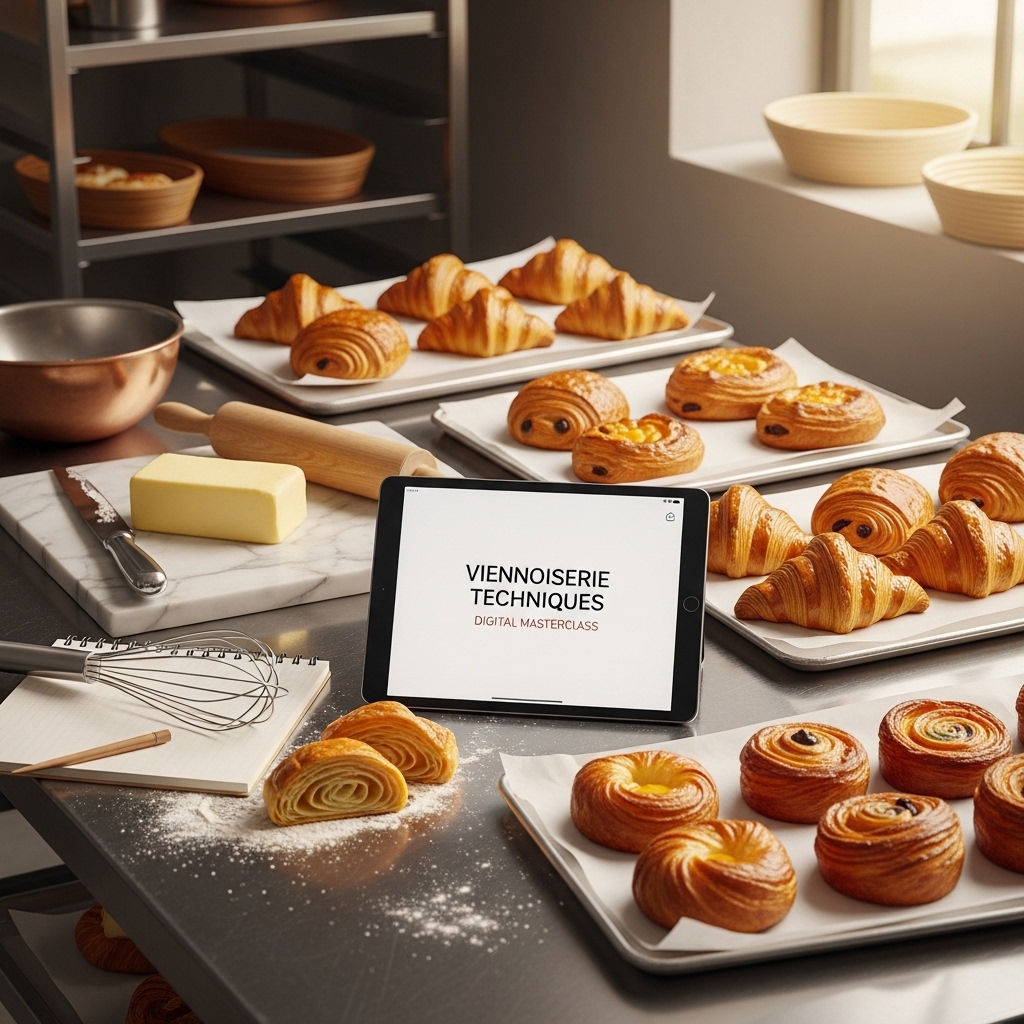


Viennoiserie Techniques Digital Masterclass
The Complete Technical Program for Croissants, Danish, Pain au Chocolat, Kouign-Amann, and the Science of Laminated Dough
Laminated dough is an act of organized patience.
The croissant that shatters when you bite it — the one with the distinct, audible crack, the honeycomb of open, airy layers underneath, the glistening crust that is both golden and impossibly delicate — is not the result of a better recipe. It is the result of a lamination process executed with precision: the right dough consistency, the right butter temperature, the right number of folds at the right intervals, the right proofing conditions, and the right baking temperature and time.
Every variable matters. Every variable is learnable.
The baker who produces a great croissant on their first attempt got lucky with the variables. The baker who produces a great croissant consistently has learned to control them — and the baker who can control the variables can extend that understanding to Danish pastry, pain au chocolat, pain suisse, kouign-amann, and any other laminated product, because the core principles are the same.
This masterclass teaches the principles. Then it teaches every product.
📥 Digital download. The complete lamination curriculum. Available immediately.
THE CURRICULUM — CHAPTER BY CHAPTER
CHAPTER 1: THE SCIENCE OF LAMINATION
The Layer Structure — What You Are Actually Making
Laminated viennoiserie is built from the repetition of a single action: a thin layer of butter between two thin layers of dough, folded, chilled, and rolled out again. Repeat. Repeat. The result of three sets of letter folds (the standard commercial croissant method) is 27 alternating layers of dough and butter. The result of three book folds is 64 layers. The result is not just more layers — it is a specific layer thickness that determines how the butter melts during baking, how the steam generated expands the structure, and how the crust forms.
During baking, the butter melts and the water in the butter converts to steam. That steam is trapped between the layers of dough — the layers that are gluten networks, elastic enough to stretch and hold the steam pressure. The steam pushes the layers apart, creating the open, honeycomb crumb. The dough layers set as the starch gelatinizes and the gluten structure firms. The butter fat that remains bastes the dough layers, producing the flaking, golden crust.
Understanding this process explains every production decision: why the butter must be cold (warm butter absorbs into the dough rather than remaining as a distinct layer), why the dough must be cold during rolling (warm dough becomes too extensible and tears over the butter), why proof time and proof temperature are critical (insufficient proof means insufficient gas development before the structure sets; over-proof means the layer structure has already begun to collapse before the oven). 🔬
The Dough Development and Gluten Structure
The détrempe — the base dough — is different from a standard enriched dough in one critical way: its gluten needs to be developed enough to hold the lamination layers and trap the steam during baking, but not so fully developed that it becomes resistant to rolling. Over-developed gluten tears over the butter block; under-developed gluten fails to hold structure during baking.
The mixing time for lamination détrempe: shorter than enriched bread dough. The window pane test adapted for laminated dough — the target extensibility rather than the target strength of bread dough. The rest period after mixing (the gluten relaxation that makes rolling possible — the step most critical for the baker using a spiral mixer that develops gluten more quickly than a planetary or hand mixer).
The détrempe ingredients and their functions: the flour selection (the protein content range that produces the right gluten strength — typically 11-12% protein, lower than bread flour, higher than cake flour), the water temperature and its effect on gluten development rate, the salt (structure and flavor, with the specific distribution caution for yeasted laminated dough — salt in direct contact with yeast affects fermentation), the sugar (fermentation fuel and color development during baking), the eggs (enrichment and emulsification), and the yeast (the fermentation agent and the timing consideration — the dough should be cold enough by the end of mixing that the yeast activity is minimal during lamination). 📐
The Beurrage — The Butter Block
The butter selection for lamination: the plasticity requirement that distinguishes beurrage butter from standard butter. High-fat European-style butter (83-84% fat versus the 80% of standard butter) has lower water content, which means less steam during baking in the wrong place (within the butter block rather than between layers) and more fat for basting. The plasticity — the butter’s ability to be malleable without being greasy — is determined by the fat crystal composition, which is in turn determined by the butter temperature.
The butter block temperature target: the range at which the butter is plastic enough to roll without cracking or crumbling and firm enough not to absorb into the dough during rolling. The test: the butter pressed with a fingertip should leave a clean impression without sinking. Pressing at room temperature leaves no impression (too cold) or the finger sinks completely (too warm). The water bath technique for raising butter temperature evenly when the butter is too cold from refrigeration.
The beurrage formation: the butter block beaten into a consistent thickness rectangle with defined edges. The envelope fold that encloses the butter block in the détrempe and seals the edges to prevent butter breakthrough during the first roll. The first roll — the most critical roll in the entire process, because if the butter is not properly incorporated into an even layer in the first pass, the subsequent folds cannot correct it. 🧈
CHAPTER 2: THE LAMINATION PROCESS
The Folding Methods
The Letter Fold (Single Fold): The dough rolled to a long rectangle, folded in thirds like a letter. Each letter fold multiplies the layers by three. The standard commercial croissant method uses three letter folds for 27 layers. The technique: the fold alignment (the dough edges meeting precisely before the fold, the fold edge perpendicular to the rolling direction), the quarter turn before the next fold (the rotation that changes the direction of the gluten development and produces a uniform layer structure), and the rest and chill between folds.
The Book Fold (Double Fold): The dough rolled to a long rectangle, both short ends folded to the center, then folded in half. Each book fold multiplies the layers by four. More efficient (fewer folds required for the same layer count) but less forgiving — the four-layer compression in one action requires more precise temperature control than the letter fold. The book fold technique and the hybrid approach (two book folds and one letter fold, used in some commercial operations).
The Rest and Chill Protocol: The minimum rest between folds. Gluten under stress needs to relax before the next fold — the baker who rushes this step produces dough that springs back during rolling and tears over the butter at the stress points. The refrigerator versus blast chiller timing (the blast chiller compresses the rest period significantly, which is why it is standard equipment in commercial viennoiserie operations).
Reading the Dough
The visual and tactile assessment skills that tell the baker whether the lamination is progressing correctly: the surface of the dough after rolling should be smooth (butter showing through the surface indicates butter breakthrough — the butter has become too warm and absorbed into the dough layer); the cut edge of the dough after all folds should show distinct layers (blurred layers indicate warm butter that has lost definition); the dough should roll with consistent resistance (significantly easier rolling than expected indicates warm dough or warm butter that has softened beyond the correct temperature range). 👁️
CHAPTER 3: THE CROISSANT
Shaping
The dough rolled to the final thickness (4mm for the classic crescent croissant — thicker dough produces a doughy interior, thinner dough produces an over-baked exterior before the interior is set), cut into isoceles triangles with the precise dimensions that produce the classic croissant size and shape after rolling and proofing.
The triangle cut: the base width, the height, and the nick at the base center — the small cut that allows the base to separate as it is rolled, preventing compression of the base layers during rolling and producing the flared ends of the finished croissant.
The rolling technique: the roll that applies consistent tension outward along the triangle as it is rolled from base to tip, producing even layer compression throughout the length of the roll. The placement on the baking tray with the tip tucked under — the technique that prevents the tip from lifting and unrolling during proofing. The curved shaping that produces the crescent form. 🥐
Proofing
The proof environment: temperature 26-28°C (78-82°F) maximum, high humidity. Above this temperature range, the butter begins to melt, the layer structure collapses, and the baked croissant is dense and greasy. Below this range, the yeast is not active enough to produce adequate gas development in a practical proof time.
The proof duration: 2.5 to 4 hours depending on the proof temperature and the initial dough temperature (dough that has been through more refrigeration time before proofing takes longer to proof than dough proofed more immediately after lamination). The proof completion assessment: the croissant should have visibly grown (approximately 50% increase in size), should jiggle when the tray is gently shaken (the gas-filled interior responding to movement — the proof that the yeast has produced the gas structure), and should feel light when the tray is lifted.
Baking
The egg wash application: the technique that produces a deep, even golden color without sealing the layers at the cut ends (egg wash on the cut edges inhibits layer separation during baking — the technique that avoids it). The baking temperature (200-210°C/390-410°F in a convection oven) and its rationale: high enough for rapid crust formation that traps the steam, not so high that the crust sets before the layers have had time to expand. The baking time and the color target — the crust should be deep golden, not pale gold. 🔥
The Diagnostics: Reading Your Croissant Results
The systematic quality assessment for every bake: the exterior (the color uniformity, the crust shatter, the layer visibility in the cross-section at the visible edge), the interior crumb (the honeycomb open structure versus the closed, tight crumb that indicates lamination failure), the base (the caramelization on the bottom crust — the Maillard reaction evidence that the oven heat reached the base correctly), the flake (the detachment of the exterior layers when the croissant is broken — the unmistakable tactile evidence of successful lamination and baking).
The failure-cause matrix: pale exterior (under-baked, egg wash too thick, oven temperature too low), dark exterior with raw interior (oven too hot — the solution is lower temperature with longer time), dense interior with visible butter leakage (over-proof, butter too warm during lamination, insufficient folds), no layer definition (butter absorbed into dough — temperature control failure at any stage). 🛠️
CHAPTER 4: PAIN AU CHOCOLAT, PAIN AUX RAISINS, AND DANISH
Pain au Chocolat
The shaping method that differs from the croissant: the rectangle cut, the chocolate placement (the specific chocolate type — the bittersweet chocolate batons or the couverture discs rated for high-heat baking stability, not the chocolate that melts to a greasy pool), and the rolling tension that seals the chocolate inside without tearing the layers. The proofing and baking parameters (essentially identical to croissant) and the common pain au chocolat failure (the chocolate escaping the seal during baking — the seam placement technique that prevents it).
Pain aux Raisins (Snail / Escargot)
The crème pâtissière preparation for the filling (the stability requirement — the pastry cream must hold structure during baking, which requires a slightly higher starch content than the pastry cream served cold), the raisin preparation (the soaking technique for plump, soft raisins rather than the dried-out raisins that produce texture contrast the product does not need), the assembly on a sheet of rolled laminated dough, and the cutting technique that produces the spiral cross-section rather than compressing the layers. The proofing and baking parameters.
Danish Pastry
The differences between Danish dough and croissant dough: the higher egg content, the higher fat content from both butter and sometimes additional fat in the dough, and the different proofing parameter (Danish proofs at a lower temperature than croissant because the higher fat content lowers the melting risk threshold). The base Danish shapes — the pinwheel, the envelope, the braid, the bear claw — and the filling options (the cream cheese filling, the almond cream, the apple filling, and the custard cream). 🍩
CHAPTER 5: KOUIGN-AMANN AND SPECIALTY LAMINATED PRODUCTS
Kouign-Amann
The Breton specialty that occupies the intersection of bread dough, lamination, and caramelization. The base dough is a lean bread dough rather than an enriched viennoiserie dough — the lower fat and sugar content in the base is correct because the sugar is added during lamination rather than in the dough itself.
The process: the lean dough made and proved to double, the sugar laminated into the dough in two folds (the technique — the sugar cutting into the gluten structure, which is a controlled version of what sugar does to dough at low inclusion rates), the baking in a buttered and sugared tin that produces the caramelized base and sides, and the finish — the sticky, shatteringly caramelized crust on the outside and the soft, sugar-infused bread-like crumb inside.
The common kouign-amann problem: the sugar not caramelizing evenly (the sugar distribution technique in lamination that addresses this). The second common problem: the bottom burning before the top is set (the oven temperature adjustment and the tin placement that distributes heat correctly).
Croissant Dough Applications
The extended applications of mastered croissant dough: the cube croissant (the shaped and fried variant), the filled and dipped variations, the cruffin (the croissant dough muffin-shaped and baked), and the laminated waffle dough (the Belgian style using laminated dough rather than batter for a croissant-textured exterior). 🌀
CHAPTER 6: PRODUCTION PLANNING FOR VIENNOISERIE
The Viennoiserie Production Timeline
The multi-day production schedule that produces viennoiserie efficiently: Day One (the détrempe mixing and overnight refrigerator rest), Day Two (the lamination and overnight refrigerator rest in the final folded state), Day Three (the cutting, shaping, proofing, and baking). The timeline that distributes the active work across days, makes production predictable, and allows a small team to produce viennoiserie at volume.
Retarding and Freezing for Production Efficiency
The refrigerator retarding approach (the shaping completed and the tray placed in the refrigerator for a slow, cold overnight proof — the croissants baked directly from the refrigerator the following morning, requiring only a fifteen to twenty minute ambient warm-up before baking), and the freezing approach (the fully shaped and un-proved croissants frozen and held for future use — the thaw and proof protocol that produces a result comparable to fresh).
The Quality Control System
The batch record system for viennoiserie production: the butter temperature at each lamination stage (the temperature log that diagnoses lamination failures retrospectively), the dough temperature after each mixing stage, the proof start and end times, the baking temperature and time, and the quality assessment result. The record that produces consistent results rather than inconsistent ones because the variables are tracked and understood. 📋
📂 COMPLETE FILE LIST
🥐 Complete masterclass PDF — all 6 chapters (A4 and US Letter, extensively annotated throughout) | 🔬 Lamination science reference guide — the layer structure, butter behavior, and baking physics (PDF) | 📊 Dough and butter temperature log template (print-ready for bench use) | ⏱️ Three-day production timeline template (editable) | 🛠️ Failure-cause-solution matrix for laminated viennoiserie — 18 failure types (PDF) | 📋 Croissant quality assessment scorecard (editable) | 🧈 Beurrage temperature and plasticity guide with visual reference (PDF)

Reviews
There are no reviews yet.