
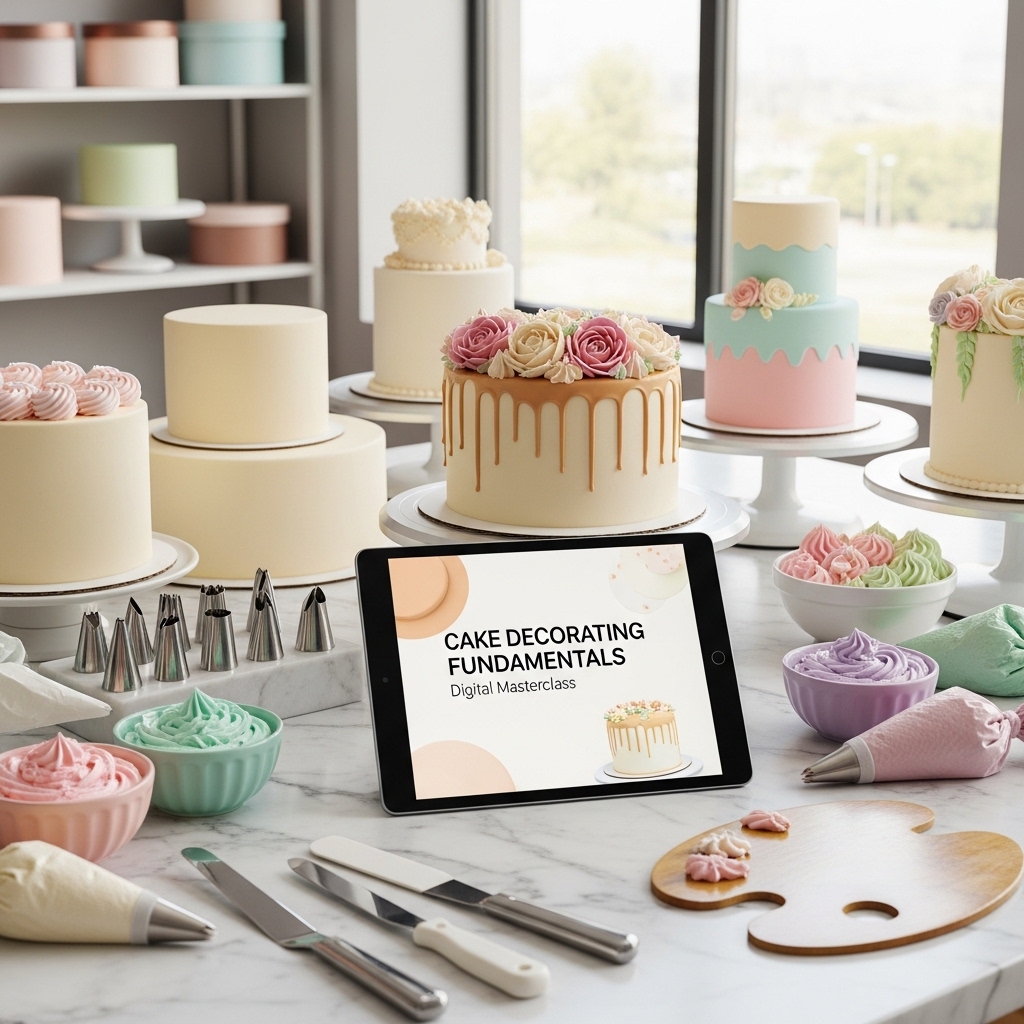

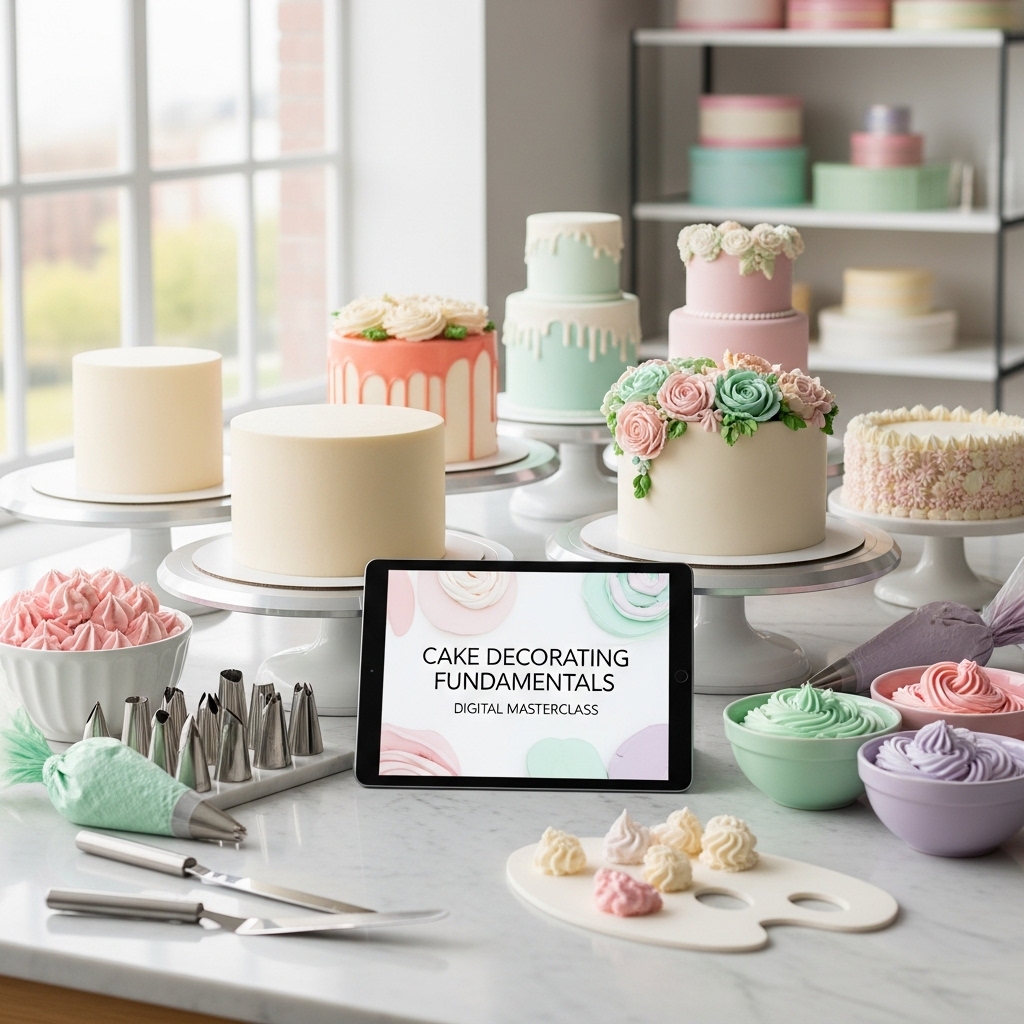
Cake Decorating Fundamentals Digital Masterclass
The Complete Technical Training Program for Smooth Finishes, Buttercream Mastery, Fondant Precision, and Professional Decoration Techniques
🎂 WHAT THE FIRST CLEAN CAKE ACTUALLY FEELS LIKE
You have made good cakes. You know your flavors work. Customers have loved the taste.
But the first time you run a scraper around a freshly chilled cake and it comes away leaving a genuinely smooth, even, crisp-edged buttercream surface — the kind of finish you have been trying to achieve for months — something clicks. Not just the technique. The understanding of why the technique works, which is the thing that makes it repeatable rather than occasionally lucky.
That understanding is what separates the decorator who produces a smooth finish when everything goes right from the decorator who produces a smooth finish reliably, in production conditions, on a timeline, when the kitchen is warm and the client is collecting in two hours.
This masterclass is built around that understanding. Not a collection of tutorials. A structured technical curriculum that goes from the foundations — the leveling, the filling, the crumb coat — through to the advanced decoration techniques, with the why behind every step explained alongside the how.
📥 Digital download. All modules in PDF format. Study at your own pace, return to any section as needed.
THE CURRICULUM — MODULE BY MODULE
MODULE 1: THE CAKE FOUNDATION
1.1 — Leveling and Torting
The work that happens before any buttercream touches the cake determines whether the finished product is level, stable, and dimensionally correct. The leveling process: the equipment options (the turntable and scraper method, the cake leveler, the serrated knife and eye method — the pros, cons, and appropriate applications of each), the identification of the high point of the cake (which is not always the center), and the leveling technique that removes the minimum amount of cake to achieve a flat surface.
Torting — the splitting of the cake into layers for filling — requires consistent cut depth to produce layers of equal thickness. The technique guide: the ruler-and-toothpick guide method for consistent depth marking before cutting, the serrated knife technique for a controlled horizontal cut, and the identification and correction of an unintentionally angled cut.
The layer inspection: what to look for before assembly that indicates a leveling or torting problem that is easier to address now than after the cake is assembled and crumb-coated.
1.2 — Filling and Dam Construction
The filling is the flavor work. It is also structural work — and getting the structure wrong is one of the most common causes of decorated cakes that look right and then develop a bulge hours later as the filling shifts.
The dam construction: the piped ring of stiff buttercream around the inner perimeter of each layer, creating a contained space for the filling. The dam stiffness requirement (stiffer than the filling, able to hold its shape under the weight of the layer above), the dam height (slightly higher than the filling depth, compressed to level under the next layer), and the gap identification and filling before stacking.
Filling types and their structural requirements: fresh fruit fillings (the moisture management, the pectin-set option for fillings that need structural stability), fresh cream fillings (the refrigeration requirement and the timeline implications for cakes with fresh cream fills), curd fillings (the dam requirement — curd without a dam will breach the buttercream at the sides under pressure), ganache fills (the setting time required before stacking), and mousse and Bavarian fillings (the refrigeration set time before stacking, the layer stability requirement). 🍓
1.3 — The Assembly and Doweling System
Stacking cake layers for a single-tier cake versus the doweling system required for tiered cakes: the dowel placement calculation (the number and position of dowels that supports the weight of upper tiers without dowel-through-board incidents), the dowel cutting technique, the board-to-board stacking approach, and the transport stability considerations for multi-tiered cakes.
MODULE 2: BUTTERCREAM MASTERY
2.1 — Buttercream Types and Their Technical Properties
The five buttercream types used in professional cake decorating, each with different technical behavior, different applications, and different environmental tolerances:
American Buttercream: The simplest formula — icing sugar beaten into fat (butter, shortening, or a combination). High sugar content produces stability but sweetness intensity that many clients find excessive. The formula adjustment for reduced sweetness (the addition of cream cheese or the use of a smaller ratio of sugar with the reduction in yield acknowledged). The crusting behavior of American buttercream and how it relates to the Viva method for smoothing.
Swiss Meringue Buttercream (SMBC): Egg whites and sugar heated together over a bain-marie, beaten to stiff peaks, then butter incorporated. Silky, less sweet than American, with a texture that many decorators prefer for smooth finishes. The critical technique points: the temperature at which butter is incorporated (too cold and the buttercream breaks and looks curdled — the recovery technique; too warm and the butter melts rather than emulsifies — the refrigeration recovery technique), and the over-whipping problem (the buttercream that becomes dense rather than silky).
Italian Meringue Buttercream (IMBC): Hot sugar syrup poured into whipped egg whites, then butter incorporated. The most stable of the meringue buttercreams. The sugar syrup temperature (the soft ball stage — 118-120°C/244-248°F — and the temperature testing approach with and without a thermometer), the syrup pour technique (the thin, continuous stream poured against the side of the bowl while the mixer runs), and the butter incorporation temperature requirement.
French Buttercream: Whole eggs or yolks beaten with hot sugar syrup, then butter incorporated. The richest flavor, the most egg-forward, the least structurally stable in warm conditions. The applications where its flavor justifies the reduced stability: filled pastries, entremets, and applications not exposed to ambient temperature for extended periods.
German Buttercream (Custard Buttercream): Butter beaten into a cooled pastry cream base. Stable at cool room temperature, highly emulsified, with a custard flavor that works particularly well in Central European pastry styles. The pastry cream preparation technique for buttercream base. 🧈
2.2 — Coloring Buttercream
The colorant types and their behavior in buttercream:
Gel food colors: The standard for buttercream coloring. The concentration difference between economy gel colors (available in any baking supply store) and professional gel colors (AmeriColor, Colour Mill, Sugarflair — the pigment density that allows deep color with minimal gel addition, preserving buttercream texture). The mixing methodology for consistent color throughout the batch.
The color shift issue: Many food colors shift in intensity after mixing — purple tends toward blue, red tends toward orange-red at high pH. The advance preparation strategy: mixing colored buttercream at least four hours before use to allow the true final color to develop before assessing and adjusting.
Deep and dark colors: The technique challenge for black, navy, deep red, and burgundy — colors that require high pigment concentration. The chocolate base technique for black and dark brown (chocolate ganache stirred into the buttercream before color addition, reducing the pigment load required). The minimum resting time for deep colors before assessment.
Marbled and ombré effects: The technique for producing intentional multi-color buttercream effects through controlled blending — the spatula smearing method for direct marbling, the layered ombré application technique for graduated color on the cake side.
2.3 — The Smooth Finish System
The technique that most cake decorators spend the most time trying to master. The smooth finish is not one technique — it is a sequence of conditions and steps that must all be correct:
The crumb coat: The thin first layer of buttercream that traps loose crumbs and sets the stage for the final coat. The crumb coat consistency (thin enough to apply without tearing the cake surface, thick enough to create a smooth base coat), the full coverage requirement (no exposed cake surface), and the refrigeration set time (the minimum time for the crumb coat to set firm before the final coat — the most frequently skipped step that causes the most smoothing problems).
The final coat application: The buttercream temperature for application (slightly softer than fridge temperature — the consistency that spreads without dragging), the palette knife loading technique, the initial rough coat application (thick enough to provide material to scrape away, thin enough not to be wasteful), and the turntable rotation that distributes the coat evenly before the scraper is applied.
The scraper technique: The bench scraper held at a consistent angle (perpendicular to the turntable surface — the angle variation that creates thick and thin spots), the continuous turntable rotation during scraping (the hand position that prevents the scraper from stopping and leaving marks), the chilling step between scraper passes (the step that makes the second pass more effective than the first), and the top edge finishing technique.
The sharp-edge finish: The technique variation for cakes where a defined, crisp top edge is required. The Masonite or acetate collar method, the scrape-and-reveal technique, and the common sharp-edge failures with their causes and corrections. 🔪
MODULE 3: FONDANT TECHNIQUES
3.1 — Fondant Preparation and Conditioning
The ready-to-use fondant conditioned for the specific application: the kneading technique and the target pliability, the colouring method (the gel color addition and kneading technique for even color distribution), and the common fondant preparation problems (the fondant that tears on kneading — the moisture addition technique using cooled boiled water or vegetable shortening; the fondant that is too soft and droops on the cake — the powdered sugar kneading technique).
3.2 — Covering a Cake in Fondant
The rolling technique for even thickness (the rolling guide ring method versus the experienced eye method), the transfer technique (the rolling pin method for moving the rolled fondant to the cake without tearing), the smooth application sequence (the top surface first, then the sides worked downward in a single continuous motion to prevent pleating), and the pleating and fold correction techniques for the side curves that form at the base of round cakes.
The sharp corner technique for square cakes — the result that most distinguishes professional fondant work from amateur application, achieved through the panel method (separate panels applied to each face) or the single-sheet technique with corner manipulation.
3.3 — Fondant Decoration Techniques
Cut-outs: the cutter types (sharp metal versus plastic — the difference in result), the fondant thickness for different decoration scales, the drying time before application, and the edible adhesive options.
Modelling and sculpting: the tylose or CMC addition for fondant that holds its shape when modelled, the basic form building techniques, and the tool set for detail work.
Embossing and texture: the embossing mat and roller technique, the lace mat application, and the impression tool use for surface detail. 🌸
MODULE 4: PIPING TECHNIQUES
4.1 — The Piping Bag and Nozzle System
The piping bag loading technique that prevents the split bag, the nozzle coupling system, the bag filling level (the amount that gives control without bag fatigue), and the bag grip and pressure control fundamentals.
4.2 — The Core Piping Techniques
The techniques demonstrated with full instruction including the hand position, the bag angle, the pressure application, and the common errors for each:
Rosettes (the shell-based rosette versus the swirl rosette), stars (the standing star versus the pulled star), shells (the shell border, the reverse shell border, the elongated shell), the rope border, the basketweave, writing (the pressure consistency that produces even lettering), the leaf nozzle techniques (the standing leaf, the ruffled ribbon), the petal nozzle rose (the center bud construction and the petal addition sequence that builds a convincing rose), the grass and hair nozzle, and the Saint-Honoré nozzle flame.
4.3 — Advanced Piping — Pressure Piping and Extension Work
Pressure piping for flat designs on fondant surfaces, the extension work technique for bridged lattice decoration, and the brush embroidery technique for floral surface designs. The most technically demanding piping applications, with the setup conditions (the fondant surface preparation, the royal icing consistency requirements) that make them achievable.
MODULE 5: FINISHING, PRESENTATION, AND TROUBLESHOOTING
5.1 — Edible Decorative Elements
Edible flowers (the varieties suitable for cake decoration, the preparation and preservation method), edible gold and silver leaf application, sprinkles and nonpareils (the application methods — pressed in wet buttercream, brushed onto fondant surface, applied with piping gel adhesive), and the chocolate shard and bark technique.
5.2 — The Comprehensive Troubleshooting Guide
Every common cake decorating problem, its cause, and its solution: the bubbling fondant (air trapped under the fondant — the pin release technique), the sweating fondant (the temperature differential between the cold cake and the warm environment — the timing management strategy), the bulging fill (the dam failure or filling applied too generously — the repair approach), the cracked buttercream (applied too cold or the refrigeration was too aggressive — the smoothing recovery technique), the color bleed from fondant decoration onto buttercream (the barrier coat technique), and the uneven tier heights in stacked cakes (the leveling adjustment at assembly). 🛠️
📂 COMPLETE FILE LIST
🎂 Complete masterclass PDF — all 5 modules (A4 and US Letter, print-optimized for bench reference) | 🧈 Buttercream type reference card — all 5 types with ratios and applications (laminate-ready PDF) | 🎨 Color mixing guide — achieving specific colors in buttercream (PDF) | 📋 Piping nozzle identification and technique reference (PDF) | 🛠️ Troubleshooting guide — 24 problems with causes and solutions (PDF) |

Reviews
There are no reviews yet.